
You are currently browsing the category archive for the ‘Aboriginal art’ category.

Lupulnga, by Makinti Napanangka
I was first introduced to Aboriginal painting in the early 90’s when my friend Colleen Burke returned from the Australian Outback with a cache of gorgeous pieces on bark and canvas. I sat for hours with her paintings and searched constantly for what few books were available in this country (it was, after all, back in the primitive B.I. era—Before Internet). And finding original works from these desert artists that could be seen in person was rare in North America. Scattered small shows happened here and there. I drove down to New York to see one, a group of Aboriginal paintings hanging at the United Nations which was really more of a cultural/anthropological event than an art exhibit. A gallery featuring Aboriginal work sprang up in San Francisco for a period of time and then disappeared. It was the inaccessibility of seeing this work in person that drove me to finally make an art pilgrimage of my own to Alice Springs. That trip was a life changer for me.
Much has changed over the last 20 years. First and foremost is access to the work. This year alone I have seen two major exhibits of Aboriginal works here in the U.S.: Ancestral Modern, Robert Kaplan and Margaret Levi‘s collection at the Seattle Museum (and written about here), and more recently, Crossing Cultures, the Will Owen and Harvey Wagner collection at the Hood Museum at Dartmouth. Both collections contain extraordinary works and have both been promised to the respective museums. Great paintings from this region live here now.
Second, the work itself has evolved. Aboriginal painting began at a very specific point in time—in the early 1970s. A young art teacher from Sydney, Geoffrey Bardon, brought the first acrylics and canvases to Aboriginal communities. The time between those first brushstrokes and a major art phenom was as close to overnight as success can be.
Many of the works in both of these shows are by artists who are second (and even third) generation, following on the path laid by those first pioneering elders 40 years ago. The lineage in the work is evident, but these younger painters are not caught in a derivative loop of tradition and style. The work feels fresh, exploratory and yet still elementally Aboriginal. I connect deeply with the old as well as the new.
For those of you living in the Northeast, the Crossing Cultures exhibit at Dartmouth’s Hood Museum runs through March 10, 2013.

Hood Museum

Political Storm Brewing, by Clinton Nain

Yunala, by Yukultji Napangati

Pukaratjina, by Joseph Jurra Tjapaltjarri

Close up view

Untitled, by Freda Warlapinni

Blue Water Hole, by Rosella Namok

Close up of the signatory dot technique

White Painting, by Nyapanyapa Yunupingu (on bark)
****
Previous Slow Muse posts on Aboriginal art:
Aboriginal Art, Sacred Land and Becoming Visible
Explorations in Landscape and Art
The Brush is the Least of my Weapons
Threading Through Abstraction, Micro and Macro
Barbara Weir: Grass Seed Dreaming
From the Dreaming, It Became Real
Contexts: The Museum vs The Gallery

Walu, 2008, Tommy Mitchell
On display at the Seattle Art Museum: an extraordinary (as in EXTRAORDINARY) exhibit of contempoary aboriginal art. Mostly paintings, the show has been assembled from the collection of a Seattle couple, Robert Kaplan and Margaret Levi.
Some of my favorite aboriginal painters are well represented—
Emily Kam Kngwarray, Wimmitji Tjapangarti, Doreen Reid Nakamarra, Gloria Tamerr Petyarr and Kathleen Petyarr. It also introduced me to some new favorites including Maringka Baker, Eileen Yaritja Stevens and Regina Pilawuk Wilson.
My passion for this work is a long standing one thanks to my friend Colleen Burke who first introduced me to the Utopian painters 20 years ago. And after spending time in Australia (and the Western Desert in particular) my interest has only deepened. I have a few treasured pieces in my collection that I have been looking at for years and still find compelling.
Interestingly Kaplan and Levi became passionate about this work about the same time, in the early 1990s. After Levi was hit by an Australian Post courier, they used the money from the settlement to start this collection. I like their point of view. Many of the pieces in their collection are paintings I would love to be able to view every day.
If a trip to Seattle before September 2 is not on your agenda, do the next best thing and buy the catalog, Ancestral Modern. This is a beautifully conceived book with texts by Wally Caruana, Pamela McClusky, Lisa Graziose Corrin and Stephen Gilchrist.
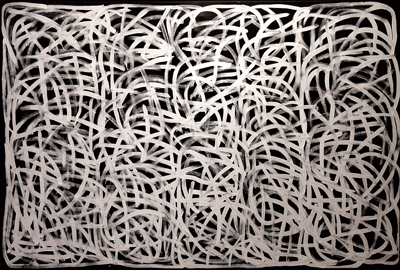
Emily Kame Kngwarreye, Linear

Minnie Pwerle, Bush Melon Seed
It is in the nature of an artist to look for commonalities between contemporary concepts of form and those of ancient or indigenous cultures. Brahms and Schubert wandered the countryside listening to and absorbing native, folk and gypsy musical idioms, incorporating many of those traditions into their compositions. Travel for me is similar, inspired by visual iconography that lies outside the Western “songline” but speaks to it nonetheless.
I certainly felt that way about encountering the aboriginal women artists of Utopia, in particular Emily Kame Kngwarreye and Minnie Pwerle. Although never exposed to contemporary western art, these women produced paintings that are conversant with something I was seeing in the work of Western artists I admired like Jackson Pollock, Brice Marden and Joan Snyder. From an earlier post on Slow Muse:
I traveled to the center of Australia with the hope that I could step deeper into understanding why I have such a powerful attraction to aboriginal art. For 15 years I have been studying these works, often only in reproduction, and my attachment has only deepened with time. While in Alice Springs, I must have looked at several thousand paintings. Sitting with some of the aboriginal artists, I was convinced that they are feeling and seeing the world in a way that is completely different than me. Their boundaries are different: It feels as if they carry the land inside them. Not the image of the land, the land.
I was struggling with the language to describe this significant difference when I fell onto an extraordinary book––Metonymy in Contemporary Art, by Denise Green. Green is an artist, an Australian, and a cerebral thinker who has articulated some of my own questions about the aboriginal world view as it relates to the context of art making.
Here is how she describes her own work: “Denise Green introduces the concept of metomymic thinking, as developed by the late poet and linguist, A. K. Ramanujan, one that is often different from what is present in Western art critical writing. In Ramanujan’s formulation of metonymic thinking, the human and natural worlds are intrinsically related to one another as are the transcendent and mundane worlds. Metonymic thinking in contemporary art implies that one must take into account the inner world of the artist. When artists create metonymically there is a fusion between an inner state of mind and outer material world.”
In her book, Green takes on the likes of Clement Greenberg and Walter Benjamin. Both have argued against subjectivity in painting, and Green asserts that the hegemony of their viewpoints in western art criticism has inhibited a deeper understanding of painting. She wants to open up the possibility of viewing contemporary art from a more “global and pluralistic perspective.”

Kira, or woman’s dress, from Bhutan

King of Bhutan, Jigme Khesar Namgyel Wangchuck. The clothes, the colors—lush, saturated, exquisite
Another body of work that speaks to me multi-dimensionally: the textiles of Bhutan. The weaving tradition in Bhutan is a famous one, and that long history of textile design does create an armature of structure that informs the work. But within that form, the colors and patternings are more than what they seem on the surface. There is something else going on.
The visual experience of Bhutanese textiles is not confined to the shops or museums. Traditional dress is required of each Bhutanese when in public, so just walking the streets of Thimphu is a visual feast.


Images from the book, Tantra Song
My lastest discovery: Abstract tantric images. the book, Tantra Songs, features the images collected by French poet Franck André Jamme. Using tempera, gouache and watercolor on salvaged paper, these images are based on hand written illustrated religious treatises dating back to the 17th century.
These images are just what I looked for when I was in India and only occasionally caught sight of. Their rarity is clear when you read Jamme’s account of how he found his way to these works. They cross over into that zone that Green describes as metonymic—a fusion between the inner state of mind and the outer material world.
My friend Altoon Sultan wrote a beautiful post about Tantra Song. I wasn’t surprised that we were both drawn to these images quite independently. Her post can be read in its entirety here.


Warren Burger, by George Augusta
My friend Carl Belz has written about his encounters with portrait art while heading up the Rose Museum at Brandeis a few years back. He was asked to recommend a portrait painter for the retiring chairman of the University’s Board of Trustees. ” I immediately suggested Andy Warhol,” Belz writes, “who was laughingly dismissed as inappropriate, and then found myself briefly stymied. The art world I knew—the art world of the 1970s, that is—didn’t include boardroom portraitists.”
He eventually finds his way to George Augusta, a Boston-based portrait painter. Stepping out of his contemporary art world view, Belz liked what he saw:
George Augusta’s signature look, a descendent of Impressionism, blended confident and airy brushwork with a perceptive eye for likeness that felt everywhere natural, allowing easy engagement with his subject, and clearly indicating he worked from direct observation. With appropriate modesty, he allowed his pictures to be about his subjects instead of about himself. Relying on neither technical virtuosity nor the trappings of class—both of which plagued the portrait genre as I had come to know it—he comfortably partnered form and content while respecting in equal measures the full energies of art and life alike.
So began a long and fruitful relationship between George Augusta and Brandeis University.
But there is a larger arc of meaning for Belz that emerges from this encounter. Anyone who has “discovered” an artistic enclave or tradition existing in isolation from a contemporary art world that is high profile, elite, detached, controlled, and carefully artificed knows that startling moment of revelation that there are other ways of making art far afield from those confining constructs.
I had my version of that aha! experience when I first encountered Australian aboriginal painting 20 years ago. Emily Kame Kngwarreye, Gloria Petyarre, Kathleen Petyarre, Johnny Warrangkula, Rover Thomas and Barbara Weir are just a few of the extraordinary artists who emerged after art supplies were first brought to the aboriginal population in the 1970s by Geoffrey Bardon. With no exposure to Western art or tradition, these artists used their own cultural heritage to produce work that, while varied and self-defined, shares an approach that is painterly, authentic, mysteriously spiritual and completely captivating. I was immediately engulfed by it, and that encounter changed my life as an artist. (An image by Kathleen Petyarre is at the bottom of this post.)
Belz describes his experience with thoughtful graciousness:
Through my association with George Augusta, I encountered a first-rate, highly successful artist working in an art world that orbited in tandem with the art world I knew but never intersected it. Had I not been assigned my unusual task—a task I admit to undertaking with reluctance, as I tacitly subscribed to the conventional wisdom of the time and so regarded boardroom portraits as mere shadows of a once noble ancestry—I would have missed entirely the rewards I discovered in George Augusta’s pictorial world. Which got me to thinking about other art worlds that might be out there, unknown and/or unrecognized by members of my art world, but the specter of what I might be missing never haunted me. I realized that I could never see every picture painted everywhere in the world at every current moment—because that kind of cultural access was as unimaginable as it was unrealistic—so I contented myself with having learned to think twice before presuming an equation between the parameters of my world and the parameters of the world at large. What did haunt me when thinking about multiple art worlds was a vision of art itself, of its vastness, of its breadth and depth, of its ability constantly to sustain and renew itself, while we—we curators, critics, art historians, and sometimes even our artists—regularly did our best to cut it down to size, bring it within our reach, and squeeze it into our theoretical constructs. I know, we’re just the messengers here, the go-betweens linking art with its audience, and I know I’m not supposed to shoot the messenger. But I also know that the messengers don’t always do justice to the message’s meaning.
Great piece Carl. You can read it in its entirety at Left Bank Art Blog.

Kathleen Petyarre

Shorty Lungkarta Tjungurrayi’s “Mystery Sand Mosaic”, 1974 (Photo: Grey Gallery)
Ken Johnson of the New York Times recently wrote a review of the show, “Icons of the Desert: Early Aboriginal Paintings From Papunya” currently on view at the Grey Art Gallery at New York University. I haven’t seen the show yet but will be down to visit in a few weeks.
Western-centric critics frequently struggle with how to review and respond to Aboriginal art, and I find that disconnect understandable. A prickly cultural confusion persists about how to “appropriately” approach non-Western art and artifacts, a discussion I have addressed in this blog on many occasions. The discomfort and reticence that is so prevalent in many responses to Aboriginal art is sometimes accompanied with a much needed caveat that this is not just a trivial cultural divide. Johnson includes his own acknowledgment of the gap that exists between our two worlds: “The Aboriginal cast of mind is so different from that of the West that even the most extensive explanations can be mystifying. ‘The Dreaming,’ a recurring subject in Aboriginal paintings that has to do with the origins of the world, is a pretty hard concept to grasp for a viewer raised on French Enlightenment-style reasoning.”
A tip of the hat to Grey Gallery for their culturally sensitive accommodation of Aboriginal tradition regarding sacred material:
At the doorway leading to the Grey’s downstairs gallery, a wall label warns away Aboriginal women and children should any happen to be visiting. Two of the paintings below are the only ones in the show depicting people, but none in the lower-level group are any more compelling than the ones upstairs. They are restricted because they represent information that only male initiates are traditionally allowed to know. They are also believed to be inhabited by dangerously powerful supernatural entities. Secularized Westerners don’t think art can have that kind of potency, but who knows, maybe that is our loss.
I can’t speak for you, but potency is what I’m looking for every day.

Rock and fungi, Tasmania, 2007
Two of the comments to my earlier post, Threading through Abstraction, Micro and Macro, came in from Down Under. Both of these writers offered a thoughtful expansion of the discussion I began in my post. My experience is that this issue of nature and abstraction has particular significance in the aesthetic milieu that is Australian contemporary art. Both of these comments bring that unique sensibility to bear.
Here are a few excerpts that are worth sharing:
About 15 yrs ago I heard it said – in relation to the meeting of the original inhabitants of Australia with the white settlers from Britain in 1788 – that this was a low tech, high psyche people meeting a high tech, low psyche people – and whilst that may come across as a clumsy or even deeply problematic statement… it certainly provoked me to ruminate on the notion of “high psyche” and divert my attention to conceptual underpinnings of the Art of Indigenous Australia – be it from Rock engravings suggested to be many thousands of years old, to bark paintings dating back hundreds of years or recent works on canvas.
I’m deeply embarrassed to think of what was taught in school during my school years in the 60’s/70’s regarding the very people whose Art has given me so much.
–Sophie Munn
The subject fascinates me and in here in Australia the dialogue, I feel, is a bit one sided. That is the indigenous contribution so outweighs the non-indigenous one that I get frustrated. We painters committed to “abstract” picture making take risks that perhaps (and the representational painters might take offense to this) separate us by the nature of the risks we take. “Just try”, I ask the landscape painters in my head when I see their paintings, “to walk into the studio without your subject matter staring you in the face.”
The indigenous artists need not do this of course because it isn’t staring them right in the face, it’s inside of them, the same way our imagery dwells within us. Have a look at some of the paintings recently on display at Utopia Fine art in Sydney this month. It never ceases to amaze me how “contemporary” the work looks.
Our language is universal—modernist or not.
–Gordon Waters
BTW, both Sophie and Gordon are gifted artists. You can see more of their work here:

Aboriginal rock painting, Kakadu, Aust. Credit: Thomas Schoch
As a follow on to my earlier post on human spaciality, Stanford assistant professor of psychology, neuroscience, and symbolic systems Lera Boroditsky has written a piece on Edge that explores how individual languages shape the way speakers think about space, time, colors and objects. She demonstrates that language has a fundamental impact on thought, “unconsciously shaping us from the nuts and bolts of cognition and perception to our loftiest abstract notions and major life decisions. Language is central to our experience of being human, and the languages we speak profoundly shape the way we think, the way we see the world, the way we live our lives.”
One of her examples was particularly provocative to me given my interest in aboriginal art and what it represents to its makers. (To read my postings on aboriginal art and culture, do a search here for “aboriginal art”.)
Boroditsky’s example:
Follow me to Pormpuraaw, a small Aboriginal community on the western edge of Cape York, in northern Australia. I came here because of the way the locals, the Kuuk Thaayorre, talk about space. Instead of words like “right,” “left,” “forward,” and “back,” which, as commonly used in English, define space relative to an observer, the Kuuk Thaayorre, like many other Aboriginal groups, use cardinal-direction terms — north, south, east, and west — to define space.1 This is done at all scales, which means you have to say things like “There’s an ant on your southeast leg” or “Move the cup to the north northwest a little bit.” One obvious consequence of speaking such a language is that you have to stay oriented at all times, or else you cannot speak properly. The normal greeting in Kuuk Thaayorre is “Where are you going?” and the answer should be something like ” Southsoutheast, in the middle distance.” If you don’t know which way you’re facing, you can’t even get past “Hello.”
The result is a profound difference in navigational ability and spatial knowledge between speakers of languages that rely primarily on absolute reference frames (like Kuuk Thaayorre) and languages that rely on relative reference frames (like English).2 Simply put, speakers of languages like Kuuk Thaayorre are much better than English speakers at staying oriented and keeping track of where they are, even in unfamiliar landscapes or inside unfamiliar buildings. What enables them — in fact, forces them — to do this is their language. Having their attention trained in this way equips them to perform navigational feats once thought beyond human capabilities. Because space is such a fundamental domain of thought, differences in how people think about space don’t end there. People rely on their spatial knowledge to build other, more complex, more abstract representations. Representations of such things as time, number, musical pitch, kinship relations, morality, and emotions have been shown to depend on how we think about space. So if the Kuuk Thaayorre think differently about space, do they also think differently about other things, like time? This is what my collaborator Alice Gaby and I came to Pormpuraaw to find out.
To test this idea, we gave people sets of pictures that showed some kind of temporal progression (e.g., pictures of a man aging, or a crocodile growing, or a banana being eaten). Their job was to arrange the shuffled photos on the ground to show the correct temporal order. We tested each person in two separate sittings, each time facing in a different cardinal direction. If you ask English speakers to do this, they’ll arrange the cards so that time proceeds from left to right. Hebrew speakers will tend to lay out the cards from right to left, showing that writing direction in a language plays a role.3 So what about folks like the Kuuk Thaayorre, who don’t use words like “left” and “right”? What will they do?
The Kuuk Thaayorre did not arrange the cards more often from left to right than from right to left, nor more toward or away from the body. But their arrangements were not random: there was a pattern, just a different one from that of English speakers. Instead of arranging time from left to right, they arranged it from east to west. That is, when they were seated facing south, the cards went left to right. When they faced north, the cards went from right to left. When they faced east, the cards came toward the body and so on. This was true even though we never told any of our subjects which direction they faced. The Kuuk Thaayorre not only knew that already (usually much better than I did), but they also spontaneously used this spatial orientation to construct their representations of time.
Thank you to Steve Durbin at Art & Perception for sending me the link to this article.
I found a wonderful blog about all things Aboriginal–Will Owen’s Aboriginal Art & Culture: an American eye. He’s been at it for some time, so there is a lot of material to review and well worth the time.
In a recent posting Owen reviews a new book by Jennifer Biddle, Breasts, Bodies, Canvas: Central Desert art as experience. From his review:
Although Biddle’s investigations rely on close examination of the works…she does not offer readings of them, or attempt to decode the symbols used in them. Her extensive analysis of paintings by Emily Kame Kngwarreye, Kathleen Petyarre, and Dorothy Napangardi likewise tells us nothing of the Dreamings of the yam, the thorny devil lizard , or Mina Mina. Instead, Biddle tells the reader early on that such translation of iconography is quite antithetical to her purpose, and suggests that the women themselves are now reacting to the practice of translation by refusing to give titles to their artworks or to provide more than the most rudimentary stories. She suggests that our eurocentric emphasis on reading–the interpretation of men’s paintings as maps with specific, knowable geographical locations embedded in them, for example–has blinded us to the true nature of these paintings. That nature is best located in the physical being, in the marks of their making that are a mimesis of the ancestral actions of the Dreaming.
Biddle wants us to turn our attention away from an intellectual analysis of the art towards an appreciation of its affect, by which she means a more visceral and pre-analytical response to the work. Such a reaction is one that is grounded in sensation, in the perception of the thickness of paint, in the visible but also palpable traces of the artist’s body in the object. This perception takes us not only to an appreciation of the artwork’s origin in body painting and scarring, but also to an appreciation of the physical connection between the artist’s brush and the canvas, or the touch of the painting stick on a women’s breast as kirda (owner) and kurdungurlu (manager, and in this sense painter) prepare for the ceremony.
Owen then goes on to say:
If we are capable of penetrating to this level of understanding through direct, sensual engagement with the artwork, then we are better positioned, even as outsiders, to appreciate the it from an indigenous perspective, to understand the power embodied in it.
There are so many ways to approach this work. Earlier on this blog I have posted a variety of viewpoints–from anthropologists, art historians, ethnographers and artists. I’m enough of a pluralist to be curious about all these points of view, but I buckle against any programmatic and proscribed determination about what the non-Aboriginal viewer can and can’t see, what we can and cannot understand. Excluding the “made for tourist” art that you see in Australia which has no intentionality beyond serving as a travel souvenir, these works have an intrinsic power. Access where and how you will.

One more excerpt from Fred Myers’ Painting Culture:
Myers highlights the distinctions between the paintings of the Pintupi tribe and the art from Balgo, just south of the Pintupi land:

Pintupi culture
valorizes some dimensions of painting–a painting’s truth in relation to the Dreaming, the right of expression as part of one’s identity–but gives no particular discursive support to…the aesthetic function.

In Balgo Hills
a different dimension of ritual painting practice has become critical; the element of touch as transferring spiritual essence…a continued emphasis on the haptic, or tactile, quality of painting, with the deployment of paint on the canvas more closely replicating the painting of bodies, focusing on the penetration of colors into the surface.

Both of these impulses–the mystical, unspoken connection with something larger than life as well as the body-based ritual and sacred gesture–speak powerfully to me.
More on the topic of Aboriginal art through the eyes of Fred Myers:
In Painting Culture, Myer quotes Nancy Munn who describes the Aboriginal relationship to their country as
an objectification of ancestral subjectivity. Places where significant events took place, where power was left behind, or where the ancestors went into the ground and still remain–places where ancestral potency is near–are sacred sites.

Myers goes on to say:
The country is not the only objectification of such processes. Other parts of Pintupi life are likewise thought to derive from the Dreaming. Pintupi understand that the Dreamings left behind at various places the creative potency or spiritual essence of all the natural species and of human beings. Thus an individual is said to “have become visible” (yurtirringu)–in reference either to “conception” [quickening in the womb] or to actual birth. The place from which one’s spirit comes determines one’s Dreaming; he or she is an incarnation of the ancestor who made the place. This understanding of personhood makes place a primary component of an individual’s identity…people are determined to have come from a particular country, literally to share its essence, for this “consubstantiality” is the primary basis for owning a sacred site. It is one’s property in an inalienable sense.
Makes complete sense to me.

 Slow Muse